Best AI Tools to Scrape Web Pages Into Clean Markdown or Structured Data
We tested four AI web-scraping tools on three live targets—a cluttered recipe blog, a JS-heavy Nike product page, and a protected Glassdoor jobs page—to see which ones return usable Markdown or structured data with zero manual selectors.
How We Tested
Each tool was run zero-shot on the same three public URLs with no custom CSS selectors, no hardcoded waits, no cookies, and no target-specific tuning. The benchmark compared how well each tool stripped boilerplate from a noisy article page, waited for client-side rendering on a Nike product page, and got usable output from a protected Glassdoor jobs page. Important scope note: although the parent use case includes strict schema-driven JSON extraction, the research team explicitly omitted that separate stage from active testing, so these results mostly measure extraction quality, layout cleaning, hydration handling, and protected-page resilience rather than full schema-constrained JSON accuracy.
The Ranking
4 toolstested head-to-head on the same input. Each card shows the verdict and per-criterion scores. Click "Full breakdown" for the artifact-level evidence.
Scores are inferred by AI from the researcher's hands-on observations and ranked by their aggregate.
Highest structural quality across the three live tests, especially on noisy and JS-heavy pages, with slower runs and some recording-sync fragility.
Most reliable text capture on dynamic and protected pages, but its Markdown stayed noisy and usually needed a cleanup step afterward.
It preserved visible text accurately but fell short on boilerplate removal, JS hydration, and anti-bot handling.
Too unreliable on this benchmark, with a broken first run, missed hydration on Nike, and conflicting evidence on Glassdoor.
Full breakdown
Every claim below is a recorded finding from our own testing — the score, the note, and the screenshots behind it. Nothing is summarised from memory.
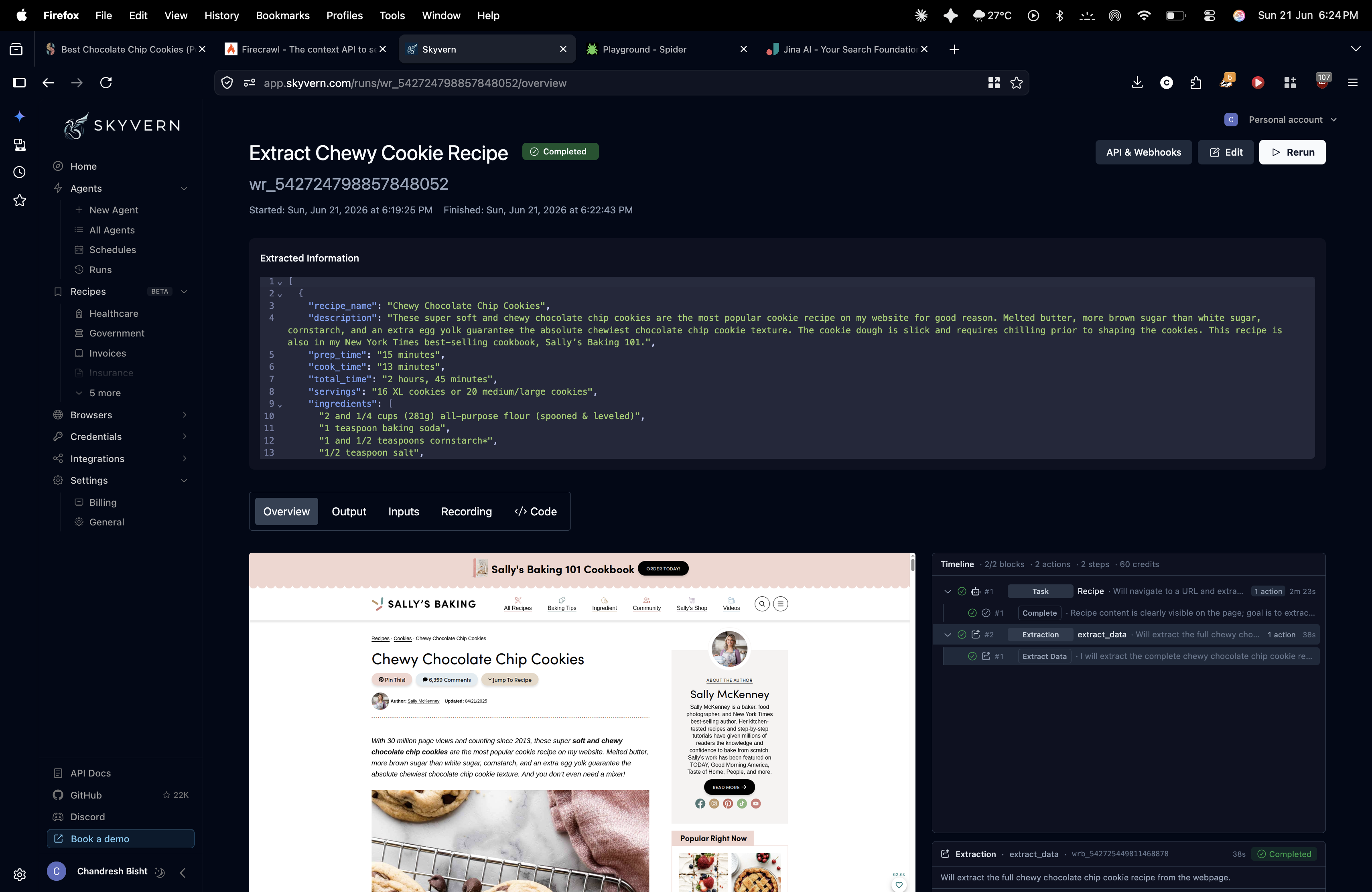
Skyvern
Best#1 of 4Best visual layout cleaning and structured extraction, with some latency and occasional recording sync issues.
How it scored
Automation Level5/5Export5/5Input 1: Noise Filtering5/5Input 2: JS DOM Hydration4/5Input 4: Proxy Evasion5/5Input Handling5/5Interaction Stability4/5JS DOM Hydration5/5Noise Filtering5/5Output Quality5/5Proxy Evasion5/5Schema Extraction Integrity5/5Visual Spatial Awareness5/5▸Automation Level5/57 worked well1 mixed8 findings
Ran end-to-end autonomously with visual navigation and no manual selectors or human intervention.
Runs the extraction end-to-end with automatic visual layout analysis, without manual selector mapping or other intervention.
Can execute the extraction autonomously, but the interface recorder can drift out of sync during the run.
▸Export5/56 worked well6 findings
Structured outputs were available as downloadable payloads from the dashboard or run directory.
Makes the structured extraction available as a downloadable run artifact / core log rather than only as a transient on-screen result.
Exposes clean structured data logs as downloadable run artifacts.
▸Input 1: Noise Filtering5/51 worked well1 finding
Ignored navigation, ads, author bio, and comments, returning a clean isolated JSON recipe array.
The tool can isolate the primary recipe content on a cluttered static page and return a clean structured extraction, preserving the requested fields while stripping surrounding boilerplate; in this run it produced a single JSON recipe object with fields such as recipe_name, description, prep_time, cook_time, total_time, servings, and ingredients while ignoring navigation, ads, author bio, and comments.
▸Input 2: JS DOM Hydration4/51 worked well1 mixed2 findings
Accurately extracted the fully hydrated Nike size schema, but the screen recorder went out of sync and froze.
The extraction pipeline recovered the hydrated Nike size data, but the screen-recording/visual trace subsystem was out of sync and froze on an initial page view, so the captured recording did not reflect the final dynamic state.
The tool can wait for client-side hydration and capture the rendered product state, including a populated size-selection grid; in this run it extracted a structured schema of the Nike Air Force 1 '07 size options and showed multiple size variants rather than an empty shell.
▸Input 4: Proxy Evasion5/51 worked well1 finding
Bypassed the sign-in modal overlay and recovered the target job content with clean structured output.
The tool can bypass a standard interstitial sign-in/modal barrier and still recover the target content, outputting structured job listings with deterministic fields such as title, company, location, and summary.
▸Input Handling5/58 worked well8 findings
Accepted each task directly and started processing through its natural-language / cloud task flow.
Accepted the provided recipe URL and started the extraction run without routing or parsing errors; the task completed successfully end-to-end.
Accepts cloud-workspace task-path parameters cleanly and starts the run without input-ingestion errors.
▸Interaction Stability4/52 mixed3 struggled3 failed8 findings
Worked reliably overall, but dynamic runs showed occasional sync issues and added latency.
Handles the page extraction itself, but the run’s live recording pipeline can fall out of sync during hydration: the report states the screen capture froze on the initial page view, making the recording unwatchable and hard to debug.
The extraction completed, but the screen-capture recorder fell out of sync and froze on an early page state, so runtime observability degraded.
▸JS DOM Hydration5/52 worked well2 findings
Captured client-rendered content from the hydrated Nike page successfully.
Executes client-side rendering successfully and extracts data from the fully hydrated DOM rather than the pre-rendered shell.
Waits for the client-rendered product page to hydrate and extracts the size grid instead of stopping at the initial shell.
▸Noise Filtering5/52 worked well2 findings
Stripped boilerplate, ads, navigation, author bio, and comments from the static recipe page.
Strips surrounding boilerplate effectively, preserving only the requested recipe content while excluding navigation, ads, author bios, and user comments.
Strips visible boilerplate well, keeping the recipe content while excluding navigation, the author card, sidebar promos, and comment clutter.
▸Output Quality5/510 worked well10 findings
Produced clean, accurate, properly formatted JSON output with strong structural fidelity.
Returns readable structured markdown/JSON-like output for job listings while stripping page noise, with the visible output preserving the listing content rather than UI clutter.
Produces a clean, readable JSON array rather than mixed prose, with consistent key/value formatting in the extracted output block.
▸Proxy Evasion5/52 worked well2 findings
Got past the Glassdoor sign-in modal and reached the underlying content.
Can get past a dynamic sign-in modal overlay and continue extraction on a blocked or gated page sequence.
Gets through a blocking interstitial/sign-in layer and reaches job listings content instead of stopping at the gate.
▸Schema Extraction Integrity5/510 worked well10 findings
Returned the requested fields with correct keys and valid schema formatting, including dynamic content.
Preserves the size data as structured paired entries instead of collapsing it into free text, yielding a line-item schema of men’s/women’s size variants.
Can accurately preserve a hydrated page’s structured output, extracting a complete schema of all 22 shoe sizes without corrupting the requested JSON structure.
▸Visual Spatial Awareness5/55 worked well5 findings
Used computer vision to isolate the meaningful page regions and ignore surrounding layout noise.
Localizes the meaningful job-listing region on a page with a sign-in overlay and filters the surrounding noise, extracting the top 3 listings rather than the modal chrome.
Can isolate the main recipe content from dense page clutter, ignoring navigation text, ads, author biography, and comments to return a clean, focused JSON array with only the requested recipe fields.
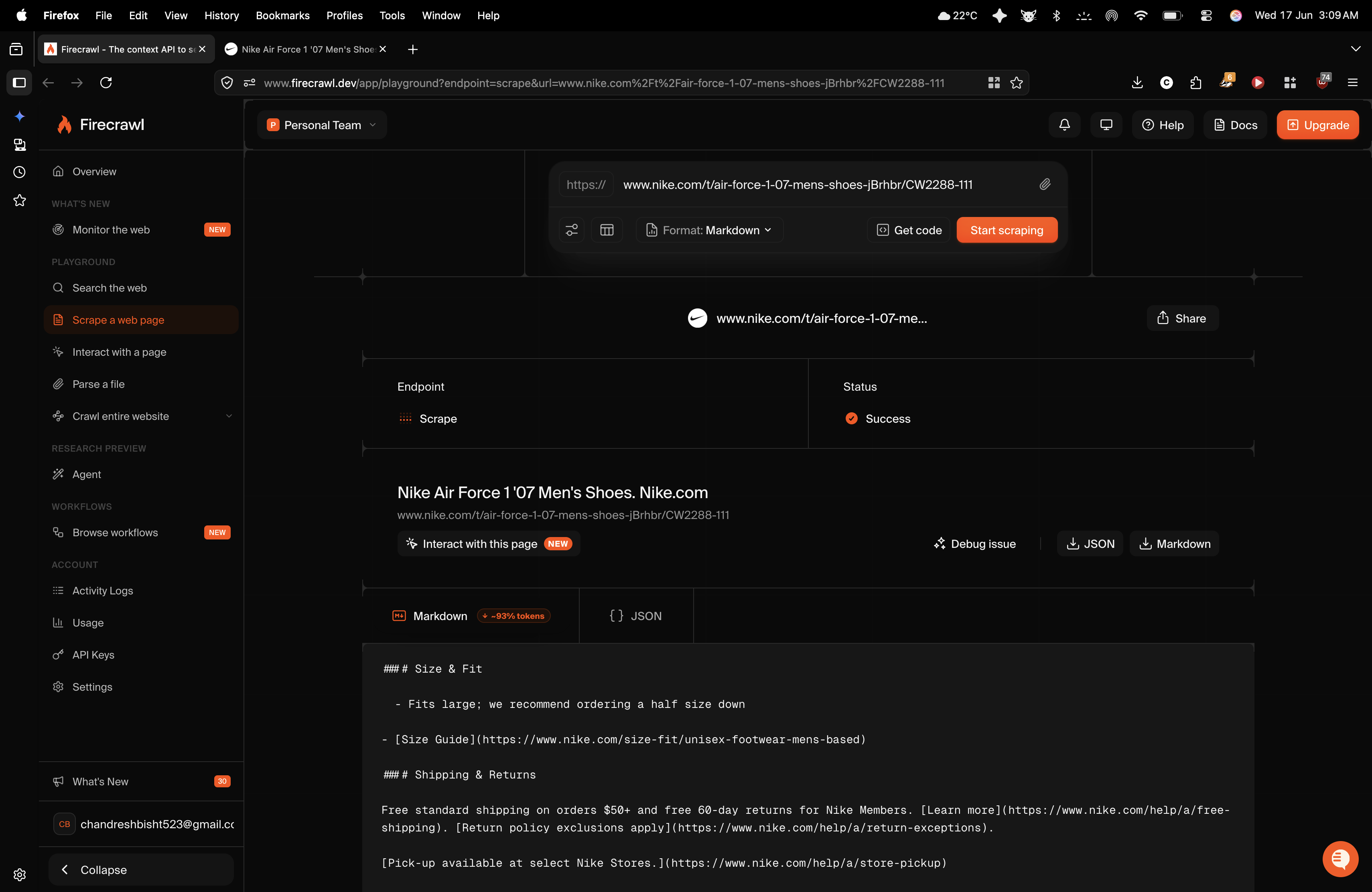
Firecrawl
Usable#2 of 4Strongest at proxy evasion and JS hydration, but weak at layout cleanup/noise filtering.
How it scored
Automation Level5/5Export3/5Input 1: Noise Filtering1/5Input 2: JS DOM Hydration4/5Input 4: Proxy Evasion5/5Input Handling5/5Interaction Stability5/5JS DOM Hydration5/5Noise Filtering1/5Output Quality3/5Proxy Evasion5/5Schema Extraction Integrity2/5Visual Spatial Awareness1/5▸Automation Level5/58 worked well8 findings
Ran end-to-end without manual selectors or mapping, including dynamic rendering and proxy handling.
Runs the extraction zero-shot with no custom CSS selector mapping or other manual intervention.
Runs fully autonomously in server-side browser mode, with no manual waiting or selector intervention required.
▸Export3/58 worked well8 findings
Results were accessible in the interface for copy/export, but not presented as a clean direct downloadable payload.
Exposes the extracted result through the web-interface display panes for direct retrieval.
Copies out as a usable web-interface dashboard payload rather than trapping the extraction in a non-exportable view.
▸Input 1: Noise Filtering1/51 worked well1 failed2 findings
Extracted the main recipe content, but semantic filtering was essentially absent and the output was cluttered with navigation, sidebar, review, and footer noise.
Does not semantically strip boilerplate on a cluttered recipe page; the markdown still contains the full primary navigation tree, sidebar components, thousands of review nodes, and footer blocks.
Recovers the recipe's primary article content with high textual fidelity, including the ingredients table and step-by-step baking workflow.
▸Input 2: JS DOM Hydration4/51 worked well1 mixed2 findings
Successfully waited for client-side rendering and captured the full dynamic size options and product state, though the output still included raw backend and asset artifacts.
Waits for client-side hydration and captures the complete size-selection grid, spanning M 5 / W 6.5 through M 18 / W 19.5.
Captures hydrated product content but leaves substantial non-content noise in the output, including raw backend code artifacts and raw media-attachment matrices.
▸Input 4: Proxy Evasion5/51 worked well1 mixed2 findings
Bypassed Cloudflare/interstitial defenses and recovered the target Glassdoor job content autonomously, despite some leftover page noise.
Bypasses Glassdoor's Cloudflare-style perimeter defenses and recovers the target job listing content, including active software-engineering listings, corporate profile names, salary estimates, and technical-skill arrays.
Returns the protected job page in a noisy flattened form, interleaving the target content with navigation buttons, search filter blocks, and internal page links instead of a cleanly isolated listing block.
▸Input Handling5/58 worked well8 findings
Processed the target URLs directly and began scraping without routing or input errors on all three tests.
Accepts the dynamic product URL directly and processes it through the scraper flow without routing or format errors.
Accepts a direct URL through the web interface without routing or ingestion errors, within standard timeout bounds.
▸Interaction Stability5/55 worked well5 findings
Executed reliably through the tested flows, including hydration and proxy-bypass cases, without losing sync.
Reliably waited for client-side hydration and captured the complete size set, from M 5 / W 6.5 through M 18 / W 19.5.
At a tool level, it can handle automated proxy rotation and user-agent manipulation without manual intervention, indicating strong anti-bot runtime resilience.
▸JS DOM Hydration5/52 worked well2 findings
Waited for client-side rendering and successfully captured the hydrated Nike size options and related dynamic content.
Waits for client-side JavaScript hydration to complete and captures the rendered inventory state, including sizes from M 5 / W 6.5 through M 18 / W 19.5.
Waits through client-side hydration and captures the dynamically loaded size inventory, spanning the full visible range from M 5 / W 6.5 through M 18 / W 19.5.
▸Noise Filtering1/51 struggled4 failed5 findings
It repeatedly preserved boilerplate, navigation, sidebars, filters, and login clutter instead of stripping them.
Fails to separate target text from page noise, returning full job detail specs immediately followed by global layout blocks and login fields.
Leaves page scaffolding in the extraction stream, including skip links and global navigation, instead of cleaning the listing output down to the core jobs content.
▸Output Quality3/52 worked well6 mixed2 struggled10 findings
Markdown/text fidelity was good, but the outputs were cluttered and not semantically cleaned.
Extracts the core job listing content, but the text structure is still interleaved with navigation buttons, search filter blocks, and internal links.
Preserves Markdown structure and core content cleanly, including headings, the ingredients table, and the step-by-step workflow, with excellent textual fidelity.
▸Proxy Evasion5/52 worked well2 findings
Successfully bypassed the Glassdoor anti-bot/interstitial barriers and returned content behind the edge protections.
Gets past Cloudflare-protected interstitial defenses and returns the underlying job-listing content from behind the barrier.
Bypasses Cloudflare-class edge defenses and returns job listings from behind the proxy layer.
▸Schema Extraction Integrity2/52 worked well2 findings
It captured some core fields and lists, but not as cleanly structured schema output with reliable field discipline.
The tool preserved the requested recipe structure with high textual fidelity, including the ingredients table and step-by-step workflow, and retained hyperlink routing definitions accurately.
The extractor returned the core job-listing payload accurately, including active software engineering listings, corporate profile names, salary estimates, and required technical skill arrays.
▸Visual Spatial Awareness1/51 mixed1 struggled6 failed8 findings
The tool did not isolate the main page region well and repeatedly captured surrounding layout noise.
Does not isolate the meaningful content region on a cluttered page; it flattens page chrome into the result instead of suppressing surrounding navigation and footer noise.
Cannot structurally isolate the recipe content on a cluttered page; the extracted text remains dominated by global navigation and sidebar noise instead of just the main article.
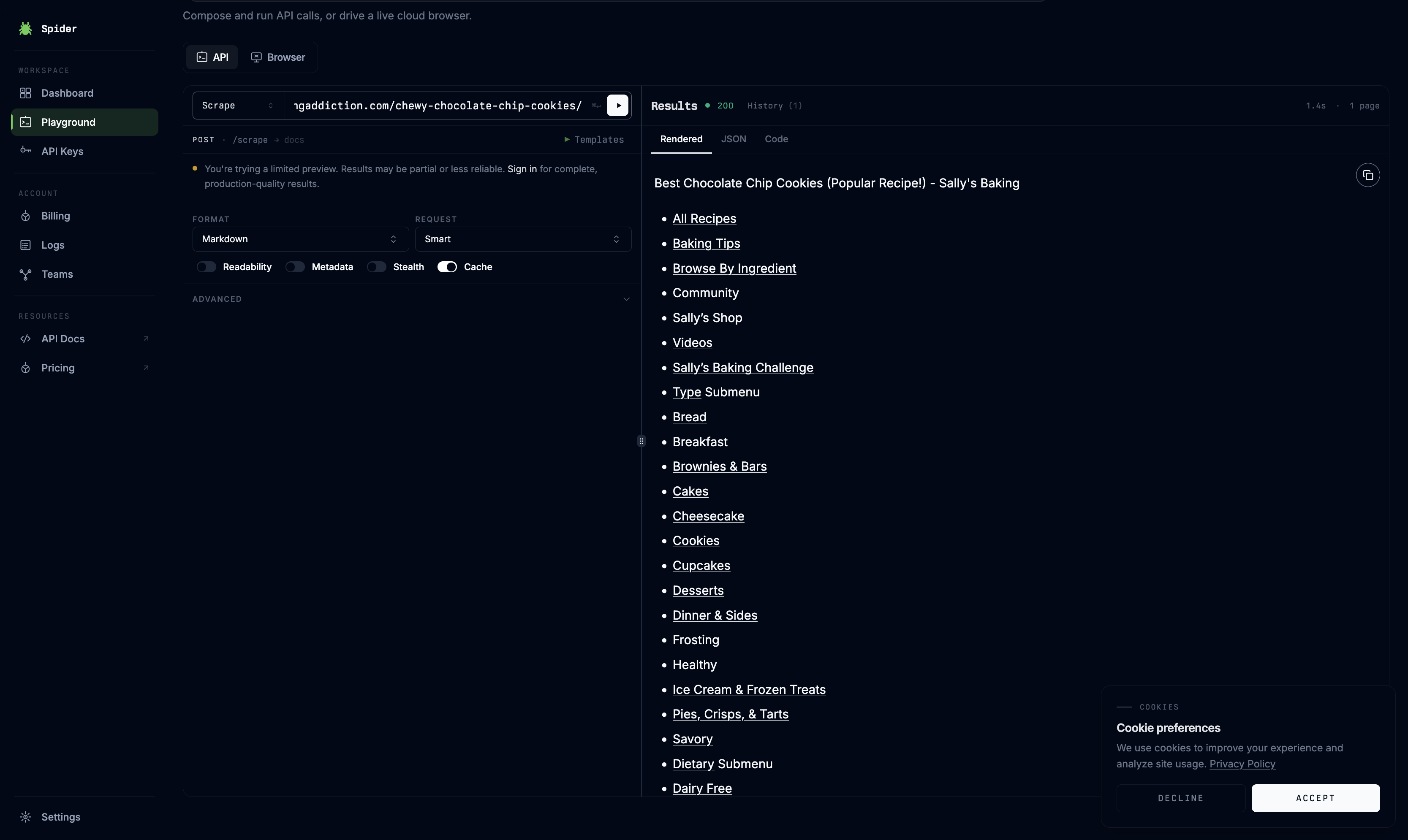
Spider
Needs work#3 of 4Fast static-page markdown scraper; weak on dynamic and anti-bot protected sites.
How it scored
Automation Level4/5Export2/5Input 1: Noise Filtering1/5Input 2: JS DOM Hydration1/5Input 4: Proxy Evasion0/5Input Handling4/5Interaction Stability2/5JS DOM Hydration1/5Noise Filtering1/5Output Quality2/5Proxy Evasion1/5Schema Extraction Integrity2/5Visual Spatial Awareness3/5▸Automation Level4/54 worked well2 failed6 findings
Ran zero-shot with internal browser/tracking handling and no manual selectors, but the third run still failed at the network edge.
Runs the scrape zero-shot through the API path, with no manual selector mapping or human intervention required.
Could not complete automation because proxy-level interception stopped the run during the initial handshake sequence.
▸Export2/51 worked well2 mixed3 findings
Outputs were accessible in the playground/workspace/viewport, but not as a clearly direct downloadable API payload.
Results are exposed directly in the workspace through Rendered/JSON/Code views, so the scrape output is exportable without a separate download step.
The result was only captured inside the central workspace environment interface, not exposed as a direct reusable payload.
▸Input 1: Noise Filtering1/51 worked well1 failed2 findings
It preserved the main recipe content, but the markdown was heavily polluted with navigation, social links, notices, and reviews.
It did not strip page boilerplate: the markdown output still included global navigation links, social/sharing URLs, cookie-preference UI, and user-review content around the recipe.
It accurately preserved the central recipe content blocks, including the ingredients and directions structure, rather than corrupting the main recipe text.
▸Input 2: JS DOM Hydration1/51 worked well1 failed2 findings
It extracted some structural/marketing text, but failed to wait for client-side hydration and missed the size-selection data entirely.
It failed to wait for client-side hydration of the size picker, leaving the size-selection area empty and returning zero available sizing attributes.
It captured the rendered product headline and basic metadata, including the Nike Air Force 1 '07 title, the Men's Shoes label, and the $115 price.
▸Input 4: Proxy Evasion0/51 failed1 finding
It was blocked at the network edge by proxy/firewall defenses and returned no useful page content.
It was stopped by the site's security interstitial and returned only anti-bot warning text instead of the target listings, showing no recovered job content.
▸Input Handling4/56 worked well3 failed9 findings
Accepted all three target URLs in the playground/smart modes, though the Glassdoor run was blocked by the target rather than by an input error.
Accepted the Nike product URL under the Smart performance configuration and returned a successful scrape result without routing errors.
Accepted the recipe URL cleanly through its cloud scraper playground interface and returned a successful scrape result without routing or input-format errors.
▸Interaction Stability2/52 struggled4 failed6 findings
Handled the static case, but failed on the dynamic Nike page and then hard-blocked on the Glassdoor run.
Execution was cut off during the initial handshake, ending on a full block page with a Cloudflare server Ray ID signature.
Against a proxy- and anti-bot-protected page, execution can stop at the network edge before any usable payload is returned, leaving only CAPTCHA/security-warning text and a Cloudflare block page.
▸JS DOM Hydration1/52 failed2 findings
Did not wait for or capture the Nike page's client-side rendered size-selection content, leaving the dynamic nodes missing.
Does not wait for client-side hydration long enough; it can capture the title and price but misses the size-selection UI entirely, leaving zero available sizing attributes.
The scraper does not reliably wait for client-side JavaScript hydration: it bypassed the size-selection dashboard entirely and returned an empty layout node with 0 available sizing attributes.
▸Noise Filtering1/52 failed2 findings
The static recipe markdown was heavily polluted with navigation, sharing URLs, cookie notices, and reviews.
Fails to strip static-page boilerplate: global header navigation, social sharing links, cookie-preference notices, and user-review text remain in the extracted output.
The scraper fails to strip static boilerplate from cluttered pages: the markdown included the global header navigation, social-sharing URLs, cookie-choice notices, and user reviews instead of isolating only the core recipe content.
▸Output Quality2/54 mixed2 struggled5 failed11 findings
Produced some accurate content, but the recipe output was bloated, the Nike output was incomplete, and Glassdoor returned only security text.
The extractor preserves the main recipe content accurately, including the ingredients block and directions layout, but the returned markdown is highly unrefined and bloated with boilerplate text.
Extracted the product title, category, and price cleanly, but the result remained incomplete because the dynamic size inventory was not captured.
▸Proxy Evasion1/52 failed2 findings
Native proxies failed against Glassdoor's firewall/CAPTCHA, producing a full block page instead of content.
The scraper cannot reliably evade standard anti-bot defenses: native proxies failed to mask its identity, triggering a full Cloudflare block page with a server Ray ID signature and cutting execution off during the initial handshake.
Native proxy handling fails against anti-bot protection, triggering a full 'Humans only' Cloudflare-style block page instead of the target listings.
▸Schema Extraction Integrity2/51 worked well1 mixed2 findings
It could surface some structured-looking content, but missed key requested fields on the dynamic page and returned no usable schema on the blocked page.
It can preserve the main recipe content accurately, keeping the central ingredients block and recipe directions layout intact.
It can still extract static metadata cleanly, such as structural description definitions and basic marketing attributes, even when the dynamic transactional section is missing.
▸Visual Spatial Awareness3/51 struggled1 failed2 findings
It preserved the main recipe content block well, but did not reliably isolate meaningful content from surrounding layout noise.
Its structural-cleanup is weak on cluttered static pages: it leaves global navigation links, social-sharing URLs, cookie notices, and user reviews in the markdown instead of isolating the core page content.
Its structural filtering did not isolate the main article block, so the markdown still included large amounts of surrounding page boilerplate.
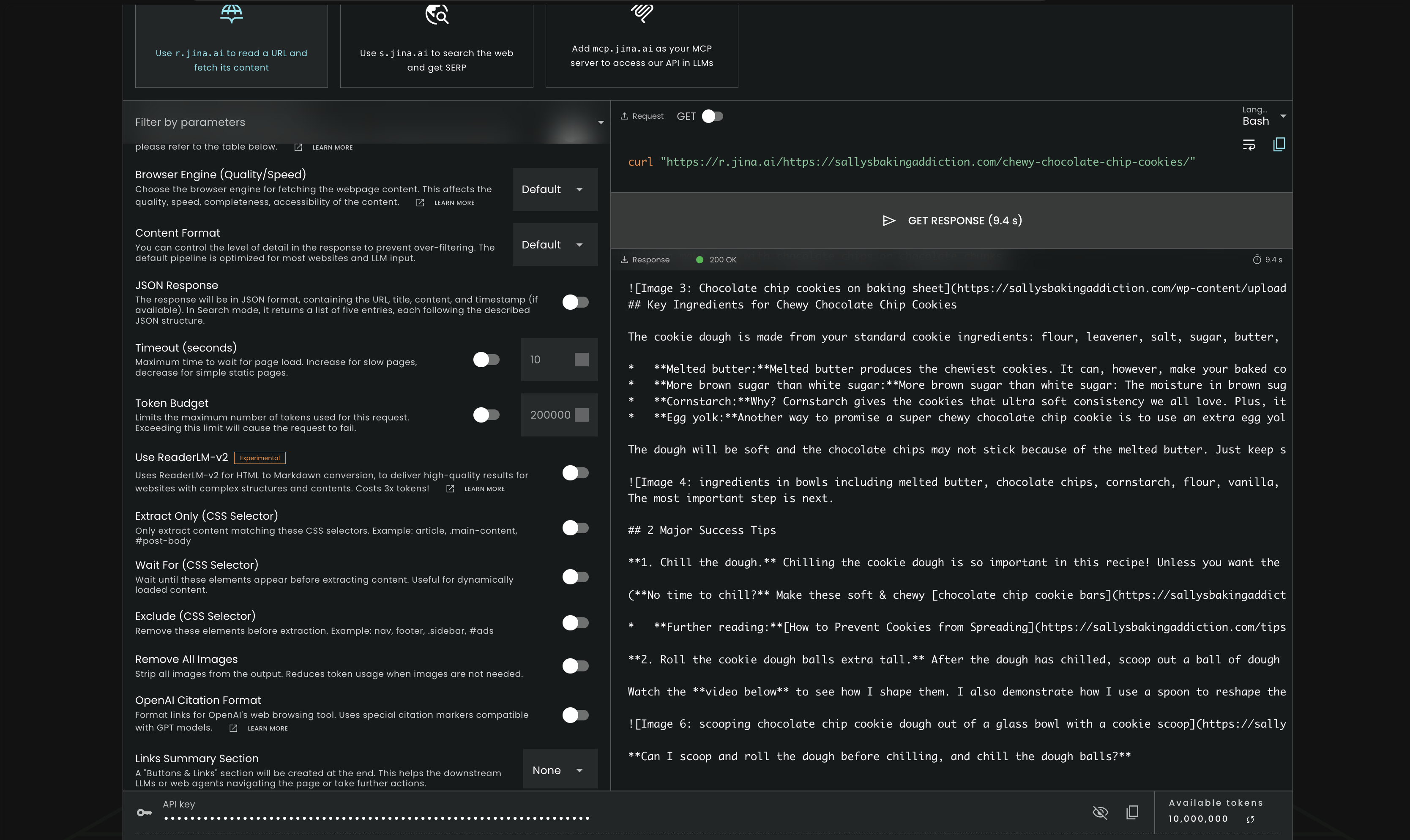
Jina AI Reader
Failed#4 of 4Strong raw-text access and occasional proxy bypass, but weak on hydration and clean structured extraction
How it scored
Automation Level4/5Export3/5Input 1: Noise Filtering1/5Input 2: JS DOM Hydration1/5Input 4: Proxy Evasion5/5Input Handling3/5Interaction Stability2/5JS DOM Hydration1/5Noise Filtering1/5Output Quality2/5Proxy Evasion4/5Schema Extraction Integrity1/5Visual Spatial Awareness1/5▸Automation Level4/55 worked well1 mixed6 findings
Ran end-to-end on the server without manual selectors or human intervention.
Processes a protected page fully automatically on the backend, without requiring manual intervention to dismiss the security layer.
Runs are fully hands-off through the API request path: the interface shows generated curl requests and default settings, with no manual selector mapping or other user intervention visible.
▸Export3/51 worked well1 finding
Results were accessible as readable raw text in the browser-facing output, but no explicit downloadable payload was shown.
The extracted text is available directly in the API response pane, so results are exportable without a separate download step.
▸Input 1: Noise Filtering1/51 mixed1 failed2 findings
It got trapped on a 404 address loop and returned mostly site chrome/boilerplate instead of the recipe content.
Even when the main fetch is broken, the engine can still surface boilerplate elements such as header navigation and privacy-disclosure content in markdown, showing partial extraction of non-primary page chrome but not semantic filtering of the article itself.
A duplicated target URL can trigger a nested-path resolution bug that returns a plain HTTP 404 page inside the site chrome, so the extractor fails to isolate the main recipe block.
▸Input 2: JS DOM Hydration1/51 mixed1 failed2 findings
It failed to wait for client-side hydration, scraping menus and layout noise rather than the product size data.
It fails to wait for client-side hydration on the size-selector grid: the response leaves the selector as empty layout nodes and instead spills the site-wide international menu and regional index into the output.
The engine can recover static product metadata from a JavaScript-heavy product page, including the title "Nike Air Force 1 '07 Men's Shoes" and the $115 price, but it does not needlessly enrich the dynamic state beyond those static markers.
▸Input 4: Proxy Evasion5/51 worked well1 struggled2 findings
It bypassed the Glassdoor edge/security barriers and recovered page text successfully, despite noisy output.
The backend can bypass a standard Glassdoor "Humans only" interstitial and return page text in about 3.6 seconds, indicating that basic anti-bot and proxy barriers were cleared in this run.
Although the anti-bot wall is bypassed, the recovered Glassdoor output is still a raw DOM dump with sign-in notices, framework noise, and header redirects interleaved, so the target listings require heavy downstream cleanup.
▸Input Handling3/56 worked well2 failed8 findings
Usually accepted the URLs and started processing, but one run hit a nested URL-resolution loop and misrouted the target.
The engine can mis-handle URL ingestion by folding the target into a nested directory query (`.../chewy-chocolate-chip-cookies/https:/sallysbakingaddiction...`) instead of accepting the original recipe URL cleanly.
The jobs URL was accepted and processed in 3.6 s, so the reader began work without a routing or connection error.
▸Interaction Stability2/51 worked well1 struggled3 failed5 findings
Completed the runs, but the dynamic page flow was unreliable and missed key content on hydrated and protected pages.
Does not wait reliably for client-side hydration; it returns before the size grid appears and falls back to static navigation text instead of the dynamic product state.
Does not reliably execute client-side hydration on dynamic pages: the size-selector grid stayed empty, and the run returned the site’s global international menu and regional index instead of the hydrated product controls.
▸JS DOM Hydration1/52 failed2 findings
Failed to wait for and capture the client-side rendered content on the Nike SPA.
It did not capture the client-rendered size selector; after 7.0 s the extract still lacked the live size grid and showed only static page content.
It fails to wait for client-side hydration on a dynamic product page: the size selector grid comes back as empty layout nodes while the extractor instead pulls the site's international menu and regional index.
▸Noise Filtering1/51 worked well1 mixed2 findings
Poor at stripping boilerplate and framework clutter, especially on the Glassdoor and Nike outputs.
It can recover the page text layer, but the extraction still leaves job data interleaved with French and German translation strings and header redirect text, so heavy post-processing cleanup is still required.
It isolated the core recipe content into markdown while avoiding visible nav, sidebar, or comment-thread clutter in the extract.
▸Output Quality2/51 worked well5 mixed5 failed11 findings
Outputs were generally noisy or wrong: a 404 wrapper, a global directory dump, and a raw DOM dump.
It preserves the recipe title and at least 2 section headings, but leaves markdown image references and extra prose in the body, so the text is only partially clean.
Its output quality is partial on the hydrated ecommerce page: it preserves the SEO header and static price markers, but replaces the transactional product data with a giant global link directory.
▸Proxy Evasion4/51 worked well1 failed2 findings
Successfully bypassed the Glassdoor edge/security layer in this run, though not shown as universally reliable.
It failed to get past the anti-bot barrier; the 3.6 s response is the "Humans only" block page instead of the target job listings.
The tool can bypass standard edge security filters on the Glassdoor target and is not dropped by the firewall checks in this run sequence.
▸Schema Extraction Integrity1/51 mixed1 failed2 findings
Did not preserve the requested structured fields well; extracted text was either off-target or heavily malformed by noise.
Can still extract some static fields correctly on a dynamic product page, including the SEO header and price markers, but it corrupts the requested product-specific output by substituting broad site-directory text for the size data.
Can break entirely when URL handling loops or duplicates the target path: the report says the primary output became completely useless for data compilation after an address-resolution bug.
▸Visual Spatial Awareness1/51 worked well1 struggled2 failed4 findings
Frequently failed to isolate the meaningful page region, leaving global layout, menus, and other chrome in the result.
Can isolate basic boilerplate elements from a broken page render: it still extracted header navigation and privacy-disclosure text into markdown even when the target resolved into a 404 layout.
Produces poor structural filtering on guarded pages: the recovered job text is heavily interleaved with framework noise, sign-in alerts, and header redirects, requiring substantial post-processing to clean.
Final Take
Skyvern is the best choice here if you want the cleanest output or structured data directly from messy live pages, especially when page layout understanding matters more than speed. Firecrawl is the best fallback for teams building large-scale pipelines that can tolerate noisy Markdown and clean it later with an LLM. Spider and Jina AI Reader both underperformed on modern JS-heavy or protected pages in this benchmark. The report's own closing recommendation is a hybrid: use a vision agent like Skyvern when UI interaction or modal handling matters, then pair it with a fast text flattener like Firecrawl when you need scalable downstream processing.