PDF Vector
API PDF parser that accepts hybrid and scanned documents, though the output still needs cleanup before it reads like clean markdown.
Can ingest both hybrid and scanned PDFs, but the output is not yet clean markdown
- You need an API that can ingest a mixed digital/scanned PDF without failing on upload.
- You can post-process flattened text if the parser returns markdown inside JSON.
- You want a tool that at least completes on scanned PDFs and returns parsed text.
- You need clean, directly usable markdown with preserved section and table structure out of the box.
Our take
PDF Vector accepted both the 84-page hybrid earnings report and the scanned research PDF, so the ingestion path is working. The limitation is output quality: the hybrid report came back as markdown content inside JSON with a mostly flattened structure, and the scan test only proves a successful parsed preview rather than a clearly faithful markdown export. It looks useful as a raw document parser, but this research does not show a structure-preserving converter yet.
In-Depth Review
Our detailed analysis of PDF Vector — features, performance, and real-world testing.
Feature-by-Feature Breakdown
PDF ParsingAccepted the file, but the output was flattened and JSON-wrapped rather than clean markdown.▾
Feature tested: PDF Parsing
Result: Partial
Verdict: Accepted the file, but the output was flattened and JSON-wrapped rather than clean markdown.
Expected behavior: PDF Vector can ingest and extract content from PDF documents, including a complex 84-page hybrid earnings report and a scanned research PDF. The evidence shows it accepts both file types and returns parsed content, though the output quality and structure vary.
Test case: PDF document → Image
Input type: PDF document
Input used: Input artifact (PDF document): INPUT — Target-2015-Annual-Report.pdf
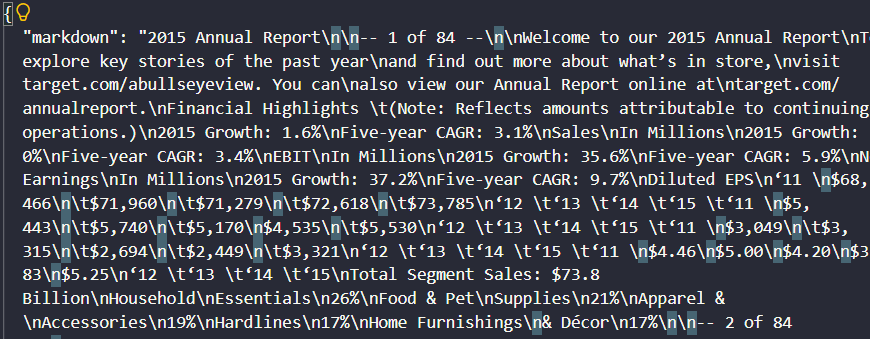
Observed output: Output artifact (Image): The response screenshot shows the Target 2015 annual report title, financial highlights, diluted EPS figures, total segment sales, and category percentages embedded in escaped JSON-like markdown, which confirms the flattened output. — raw_json_screenshot.png
Input artifact: Input artifact (PDF document): INPUT — Target-2015-Annual-Report.pdf
Output artifact: Output artifact (Image): The response screenshot shows the Target 2015 annual report title, financial highlights, diluted EPS figures, total segment sales, and category percentages embedded in escaped JSON-like markdown, which confirms the flattened output. — raw_json_screenshot.png
What changed: PDF document transformed into Image
Test case: PDF document → Text/code file
Input type: PDF document
Input used: Input artifact (PDF document): INPUT — Scanned Research PDF.pdf
Observed output: Output artifact (Text/code file): The screen recording shows the upload completing successfully, with the run finishing in 20.6 seconds for a 12-page document and the parsed preview appearing in the results pane. — md_extracted_from_json.md
Input artifact: Input artifact (PDF document): INPUT — Scanned Research PDF.pdf
Output artifact: Output artifact (Text/code file): The screen recording shows the upload completing successfully, with the run finishing in 20.6 seconds for a 12-page document and the parsed preview appearing in the results pane. — md_extracted_from_json.md
What changed: PDF document transformed into Text/code file
Why it matters / Conclusion: Good enough to ingest a complex PDF, but not yet good enough to trust as clean markdown without extra processing.
PDF Vector can ingest and extract content from PDF documents, including a complex 84-page hybrid earnings report and a scanned research PDF. The evidence shows it accepts both file types and returns parsed content, though the output quality and structure vary.
How it scored on the research's own criteria
The 7 evaluation dimensions from our hands-on research on PDF Vector, each judged from recorded runs on 2 test inputs — the same verdicts the ranking page ranks on.
held up partial failed not exercised by this input
| Criterion | Verdict | What the runs showed | Per input | Proof |
|---|---|---|---|---|
| Advanced Features (Bonus) | Mixed | No run shows separate table or chart extraction, and nothing shows confidence flags for ambiguous or low-quality regions, so the bonus features are not demonstrated here. | — | |
| Complex Document Handling | Strong5/5 | It handles a long mixed-content report end to end without breaking, which is exactly what this criterion asks for. The successful 84-page run suggests it can carry a large document through parsing cleanly rather than degrading as the file gets bigger. | open proof ↗ | |
| Markdown Quality | Mixed3/5 | It does return markdown-like text, but the result is wrapped in JSON and needs extra cleanup before it is easy to use. That is better than a dump of raw text, but not clean enough to count as strong markdown output. | open proof ↗ | |
| Reading Order & Structure | Weak2/5 | The text is readable, but the report loses its hierarchy and section breaks, so the page order is only partially preserved. That makes this a weak result: the content comes through, but the document flow does not. | open proof ↗ | |
| Table Preservation | Mixed | No run shows how it handles a table-heavy page or whether it keeps rows, columns, or merged headers intact, so there isn't enough to score table preservation. | — | |
| Text & OCR Completeness | Strong4/5Reviewer flagged — not independently verified | It reliably pulls readable text from both a hybrid annual report and a scanned paper, including page markers and numeric details, so the core OCR works well. I kept it at 4 because the annual-report proof only shows the opening pages rather than a full-document sweep, so completeness looks strong but not fully proven end to end.MISSING_INPUT_OUTPUT_MAPPING — The run evidence proves a successful parse of a file named "no-ocr-research-paper.pdf", but the declared scenario input is "Scanned Research PDF.pdf". The report never maps those two filenames to each other, so the OCR result cannot be verified as coming from the stated test input. | open proof ↗ | |
| Visual Content Retention | Mixed | There is no test showing whether charts, figures, diagrams, or images are kept in place, so visual content retention can't be judged from the available runs. | — |
Verdicts come verbatim from the study's recorded observations, never re-derived at render; a criterion with no recorded run shows Not exercised — this section cannot invent a score.
Banner Preview
How the embed badge will look on your site

Embed HTML
Copy this code to your website source
Quick Integration Guide
- 1Copy the HTML code block above.
- 2Paste it into your site's HTML or CMS editor.
- 3Banner appears instantly on your page.
- 4Links back to your tool profile here.
Similar Tools
Discover more AI tools like PDF Vector to enhance your workflow.
Comments (0)
Need a custom AI solution for this use case?
If you are looking to build a custom PDF parsing, document extraction, or markdown cleanup workflow for your business or internal workflow, email us at contact@futuresmart.ai.
Found something inaccurate or missing? We try to keep our AI research accurate and useful. If you found outdated information, an issue, or have a suggestion, email us at collaborate@aidemos.com.